Sunday, April 9, 2017

Budding Fruit Trees and Blooming Flowers

Spring is in full force here with bright green leaves and blooming flowers.  That also means insects have started snacking on those fresh, green leaves.  My little orchard with three plum trees, three peaches, three pears and five apples has sprouted back to life.  Well, except for one apple tree that refuses to leaf out.  It does not feel brittle and dead, so I'm hoping he's just a late bloomer.  I planted all the fruit trees last year, except for three of the apples.  Most of the orchard has arrived at its second growing season, so I'm not expecting an abundant crop.  The three oldest apple trees are starting their fourth growing season, so I'm keeping my fingers crossed that maybe we will harvest our first apple this year.  These three apple trees have begun to flower.

Black Twig Apple Tree Flower Buds
As the flowers bud and emerge, so do the insects that love to snack on the apple leaves and blossoms.  Little green caterpillars that I always called inch worms do much of the damage.  They are also called cankerworms here.  I sprayed the fruit trees with Bt (Bacillus thuringiensis), a bacteria that kills caterpillars.  I need to try banding my fruit trees in the fall with a sticky barrier that prevents the female moths from laying eggs in the trees.  Hopefully these caterpillars won't do enough damage to prevent me from getting a few apples this year.

Black Twig Apple Tree Blossoms
The caterpillars also eat the plum tree leaves, which have leafed out.  They did not produce any flowers this year.

Rosa Plum
The apple trees were the last to flower, which was a good thing due to our crazy warm winter. We had an extremely warm February that caused many of the fruit trees to blossom early, only to be met with a hard freeze in March.  The peach trees flowered and the frost destroyed almost all of the blossoms.  However, it appears that at least one flower survived and got pollinated.  Maybe, just maybe I will have one, delicious, juicy peach this summer!  Although note that as I took this picture, a tiny insect landed on the little peach.  I have I feeling I'm not the only one that wants a juicy piece of peach!

A tiny Julyprince peach
I'm also awaiting my first strawberry harvest.  The Seascape strawberries are small and green at this point.  I stalk them often, just in case they suddenly ripen and I need to beat the squirrels to a delicious berry.

Seascape Strawberries
Dianthus, phlox, clematis and hellebore make up the spring show in my front flower bed with bright pink and purple blooms.  I need to continue to fill the space.  I tend to neglect the ornamentals in my landscape for the edible plants.

Front Flower Bed
Another ornamental beginning to bloom is the Cherokee Brave dogwood.

Cherokee Brave Dogwood
The beneficial bug wildflower bed next to the vegetable garden has flowering clovers, Siberian wallflower and baby blue eyes.  I discovered the downfall of planting wildflowers next to the vegetable garden is that the seeds disperse all over the beds.  I think the black-eyed susans could easily colonize the entire garden!
Beneficial Bug Flower Bed
From the vegetable garden, I have been harvesting spring crops.  I pulled some of the overwintering carrots (1 lb, 6 oz) and spring planted cherry belle radishes.  I neglected to take photos of all the greens that have been coming out of the garden: lettuce, Swiss chard, spinach and cabbage.  I made an Asian coleslaw with cabbage and carrots along with a quiche with the Swiss chard.  I've been eating plenty of salads with lettuce, carrots and radishes.

Overwintering carrots and spring radishes

It tastes and looks like spring around here!


Sunday, April 2, 2017

Early April Garden Tour

We've had warm temperatures and descent rainfall the past couple of weeks, which has brought the spring garden to life.  I love seeing the bright new green growth emerge from blank beds.  Sprouting seedlings contain so much potential for delicious harvests.  I find spring a season filled with inspiration from the germinating seed to the strawberry flowers.

Join me on an early spring tour of my garden.

Two weeks ago I planted asparagus crowns that looked lifeless and brown.  I built a new raised bed using rocks, filled it with soil and buried the octopus-like root crowns.


Today I noticed that they've sprouted thin stalks!  Either I was completely oblivious and missed seeing them emerge or they shot up out of the ground really fast.  They are growing next to the pollinator flower bed and I've discovered that black-eyed susans disperse excessive amounts of seeds and will colonize the world (or at least my garden).  I'm hoping the asparagus bed doesn't get overrun with black-eyed susans.

Now just a couple of years to wait for an asparagus harvest!

In the annual beds of my garden, lots of seedlings have sprouted and are putting on new growth.  I overplanted spinach seeds because I had poor germination in the fall.  All the seeds have sprouted and grown.  I thinned and thinned some more, saving the miniature spinach leaves as microgreens to add to my salads.  Spinach has a narrow window of growth in my climate because we tend to go from cool spring temperatures to the heat of summer suddenly.  Hopefully the spinach will have time to grow before the heat arrives.


Peas germinated abundantly this spring.  Yesterday I put up their trellis since they are growing and reaching into the sky for something to cling to.  Last year aphids infected my peas, so I'm hoping for fewer aphids and more peas this spring.  I still dream of having enough peas to freeze.  It has yet to happen, but maybe this will be the year.


Spring planted turnips are abundant and green.  They are living under a row cover this year because last year I had a destructive infestation of harlequin beetles.


Carrots are notorious for poor germination, but they are looking good this year.  They are growing next to the turnips, so I ended up covering the entire root row.  However, we had some strong winds a couple of days ago and those row covers did not want to stay put!  A fifty foot row cover kite and strong winds makes for an entertaining scene for anyone watching, but not so fun for me!


Detroit red and golden beets sprouted too.  My fall beets performed poorly this year, so I'm looking forward to a beet harvest.


Mustard is one of my new crops for 2017.  I direct sowed them and they seem to be thriving.  


Celery is my other experimental new crop for the year.  I started them inside and transplanted them a couple of weeks ago.  I need to thin them, but other than that they seem to be growing fine.


The little Cherry Belle radishes beat the competition for the first spring crops.  I've never been a big radish fan, but I love to grow them since they are the closest crop to instant gratification you can get.


Fall planted garlic continues to grow and gets greener as spring gets warmer.  I'm hoping for a good garlic harvest this year.


My overwintering cabbage looks ready for harvest.  I harvested one head last week (2 lbs 11 oz), which is a good-sized cabbage for me!  I used the first head in a potato and cabbage casserole.  The next cabbage harvest will become coleslaw for a cookout this coming Friday for J's birthday.


And because gardening is a constant process, here's the newly planted cabbage seedlings.  I need to thin them too!   


Many of the herbs have put on new growth as spring arrives.  My thyme looks lush and dense with little blooms.


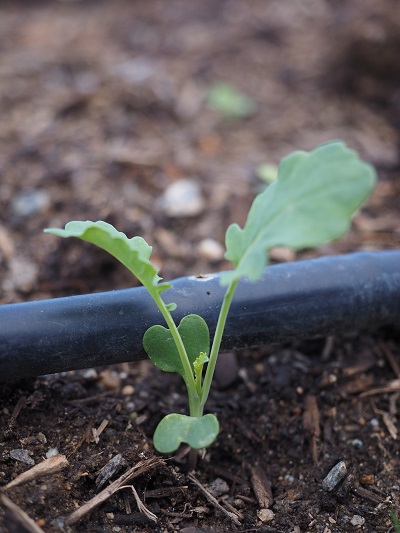
Broccoli had a rough start this spring.  We had an exceptionally warm February, but then in mid March, winter decided to return and we had a hard frost for several nights.  At this point, my broccoli were tiny and I didn't have enough row covers and I assumed that they were cold hardy.  They were too young and unprepared for the cold, so I had some causalities and do not have as many broccoli seedlings as I would like.  


Potato stems and leaves have poked out of the ground.  They too are protected under a row cover because I do not trust the potato beetles to leave anything for me.


I am delighted to see my strawberries flower and begin to form tiny, green berries.  This year will be my first strawberry harvest.  I planted them last year and I can't wait to taste the first delicious and juicy strawberry.  I have a feeling that some squirrels may also be anticipating strawberries as much as me.


That is what is going on in my garden this spring.  Soon it will be time to plant the summer crops.  I have tomatoes, peppers, eggplants, squash, melons and okra growing in little pots waiting for the sun to warm the soil so that they can move out into the garden.  I've been putting the seedlings on the back porch on warm days to help them acclimate to the sun.  Our average last frost date is mid-April.  That means that soon the gardening pace will pick up.  Spring is a lovely time to observe the greening of the garden.  It's always amazing to watch as the garden goes from empty soil to tiny seedlings that grow to towering plants producing abundant crops.  Oh the miracles of spring!


Thursday, March 16, 2017

New Beginnings

Spring promises of things to come.  It is around the corner here and with spring comes new chances.  Gardeners are an optimistic bunch.  Every year brings new hope with every seed that sprouts.  We tell ourselves that this will be the year that the garden grows lush and productive.  We will remember to do our succession planting.  We will stay on top of weeding and harvesting!  We’ve spent the cold months plotting and planning and dreaming and now it is time to get out there and make the garden grow!


Of course, there will be challenges, there are always challenges.  But each year the challenges are a little bit less insurmountable. Every year I learn a little bit more about how to successfully grow food in my corner of the world.  Every season will be slightly different.  Some years the rains come until fungi grow better than plants.  In other years, the rain is sparse and the sun is intense and the plants bake.   Gardening is never dull or predictable.  You learn to adapt and do the best you can to the changing conditions. 


Every year I like to try to grow something new.  This year I’m trying some new veggies: celery and mustard, which are completely not adapted to my climate, but that’s why they are a challenge.  Both grow best in cool weather, which we tend to avoid.  It seems our weather is either cold, warm or hot!  I’m hoping if it’s too hot here to successfully grow mustard and celery that they will at least bolt and produce seeds.  I use both of their seeds in pickling banana peppers and in some dishes.  If I end up with plenty of mustard seeds, then I can always make some mustard.  I’ve already started both celery and mustard for spring planting, but if they do not grow well in the spring I may try again in the fall.

In the herb bed, I want to add ginger and turmeric.  There’s a farm not too far from here that sells rhizomes of these and has detailed instructions about how to grow them.  Both are tropical plants, so they are not hardy here.  They require a long growing season and need to be pre-sprouted inside to ensure enough growth to get harvests before the first frost.  I use ginger and turmeric often for curries, so it’ll be nice to have some fresh flavors from the garden.

For permanent additions to my garden, I’m putting in a new bed that will hold asparagus and some perennial onions.  I’ve ordered fifty asparagus crowns: Half Jersey Knight and half Jersey Supreme.  I’ve been wanting to get asparagus planted for a few years and this is the year.  The bed is ready and my crowns should arrive Friday!  It’ll be a few years before I get to enjoy a bounty from my asparagus bed, but I’m sure it is worth the wait.  The rest of the bed will be devoted to perennial onions.  These will be planted in the fall, so I haven’t settled on what I’m planting yet.  So far I’m thinking of Egyptian walking onions and potato onions. 

Another big change for my garden this year is that it has officially become a no-till garden.    I am going into my fourth year at this garden and since I plant directly in the ground, tilling was necessary to break up the soil and turn up the never ending supply of rocks.  Tilling, however, has some negative consequences.  The soil where I live has a considerable amount of clay, so tiling can cause compaction.  Tilling also leads to increased soil erosion and I am especially concerned about this since my garden has a significant slope to it.  Tiling also breaks up the natural soil structure and the ecosystem of organisms.  I’m a bit concerned about whether weeds will be worse without tilling and whether some pests will be able to overwinter and survive better in my untilled garden.  I think in the long run no-till will make the soil healthier, but I may encounter some speed bumps along the way.  I added compost to the beds and instead of tiling; I added plenty of water and covered them with black plastic.  I am hoping this will kill any weeds in the beds and add some warmth to the soil to allow for decomposition. 


For me, gardening is constant experiment.  I’m hoping 2017 will bring some new harvests along with an abundance of my favorites.


Are you trying new things in the garden this year?