The last average frost date has passed here, which means I've been busy planting. I've planted tomato, winter squash, summer squash and melon seedlings along with massive amounts of bean seeds: black and pinto beans for dried beans, soy beans and pole green beans.
However, it you take a look at my garden you may begin to notice I have trust issues, or perhaps an obsession with row covers.
It all started innocently with row covers for my brassicas. The cabbage moths made me start. I tried picking them off and spraying Bt, but it seemed to always rain the day after spraying. I put up my first row cover using rebar and pipe for the frame and Agribon AG-15 for the covers. The cabbage moths no longer destroyed my broccoli and cabbage.
My spring potatoes get attacked by potato beetles. After trying concoctions of hot peppers, garlic and neem oil, I resorted to handpicking them. Then the light bulb moment, potatoes don't need pollination and up went another row cover.
Last spring my turnip leaves were mangled by harlequin beetles and they had no energy left to produce turnips, so this spring, up went a row cover. The beets and carrots and radishes just happened to be next to the turnips, so why not cover them as well?
Before I knew it row covers popped up everywhere.
They may not be the most attractive garden additions, but what they lack in aesthetics, they make up for in easy pest control- no spraying, no handpicking. Simple, effective and low maintenance- row covers won me over.
Of course there are crops that need pollinators or are simply too large to fit under a row cover. Last spring something kept destroying my tomato seedlings. I broke out the row cover material and my sewing machine and made mini row covers for seedlings.
They are about 18 inches wide and 24 inches tall. I anchor them down with rocks and the drip hose. Of course the tomatoes can not grow in these mini covers forever, but it gives them time to get established before being exposed to whatever bugs want to munch on them. I do the same for my eggplants. Flea beetles will decimate young seedlings here, so they get a little cover too.
I have an ongoing war with squash vine borers. I have not resorted to keeping my squash completely under row covers because that would require hand pollination. I do put the mini covers over the squash seedlings and try to keep the covers on until they begin to flower in hopes that perhaps the vine borers will miss my squash or at least have a bit later start.
There are some downfalls to row covers: wind, rips and excess moisture. It seems that we have had a spring filled with gusts of wind. I use bricks to anchor my large row covers and sometime the wind blows them free. Imagine a 50 foot kite and that's what it is like wrestling a loose row cover in the wind. This can lead to the second problem, which are rips. This material is flimsy, so it tears easily. I usually either sew up the rips or break out the duct tape, which does not improve my garden aesthetics. The third problem can be too much moisture and humidity causing fungal problems. I haven't experienced this, probably because of those excessive winds, but it is a potential problem.
For me, the negatives of row covers are outweighed by the positives. I will take a garden that looks decorated for Halloween than to have to wage the spraying and picking battle with the bugs!
Showing posts with label pests. Show all posts
Sunday, April 16, 2017
Wednesday, May 25, 2016
Turnip Leaf Damage
As I walked the rows of my garden, I noticed that my turnip
leaves were looking ragged. Something
has been chewing away on the turnip greens, which is odd. I’ve never had this problem in
the past. On further investigation, I
discovered many insects hanging out in my little turnip patch. Here I interrogate three turnip eating suspects to determine the guilty pest.
Turnip Eating Suspect #1: Grasshopper Nymph
Grasshoppers will definitely eat leaves, but this
was one small insect so I’m thinking that all the damage wasn’t due to this one
tiny grasshopper.
Turnip Eating Suspect #2: Harlequin Bug
This pretty bug isn’t a gardener’s friend. Harlequin bugs are sap suckers, so I can’t
blame it for all the eaten leaves.
However, these bugs can cause plants to wilt and die due to sap
sucking. Cabbage is one of their
favorite plants along with other Brassicas, including turnips. I found two of these in my turnips, which
isn’t a good sign and may cause problems in the future, but they are not the
ones eating the turnip leaves.
Turnip Eating Suspect #3: Yellowmargined Leaf Beetle
These little beetles look harmless. However, there are a ton of them among the
turnip leaves. This is a non-native
species from South America that has invaded the southeast of the United States. They like to eat the leaves of Brassicas and turnips are their favorite crop!
It appears I have found the guilty suspect.
The next question is what to do about these
yellowmargined leaf beetles. This
website from the University of Florida has some helpful information. For conventional growers, use of insecticides is
effective. For the organic grower, like
me, the prognosis isn’t as good. It is difficult to control their populations without synthetic pesticides. Some
good news is that they are only active during cool weather and become inactive
once the temperature is consistently above 80 F. We’ve had unusually cool weather the last week, but it is warming up, so hopefully they won’t do too much more damage.
The spined soldier bug is a predator of the yellowmargined
leaf beetles. Unfortunately I did not
see any among my turnips, yet. Maybe
reinforcements are on their way! In the
meantime, I will use my tedious pest management technique: a jar of soapy
water, my hands and the time to pick off the little bugs. I know it will be impossible to get every
individual, but hopefully if I can put a dent in their population then my
turnips can grow and survive.
Thursday, July 10, 2014
Vanishing Leaves and Murdering Dilemmas
During my morning walk through the garden, sipping my tea, I came upon a horrific site. OK, so maybe only horrific to a gardener and perhaps only an overly sensitive gardener. Anyway, one of my pepper plants was missing many leaves. Entire leaves were gone. Could it be a rabbit? I've never seen one in the backyard and Domino has a special affinity for chasing bunnies.
Then I noticed a tomato branch. A tomato branch with no leaves! No rabbit was going to eat tomato leaves five feet off the ground.
Searching the plants, I found the culprit.
A very large hornworm!!
Normally I consider myself a peaceful and non-violent person. I don't eat animals and try to not harm animals. Gardening, however, has turned me into a much more violent person. I now roam around my garden with a kill jar filled with soapy water and happily dunk Japanese beetles, squash bugs, and lately Mexican bean beetle larva. I can't squish bugs yet.. I still find that too gross.
I put the hornworm in a jar and debated it's fate. It was pretty in a Very Hungry Caterpillar kind of way. I finally decided to take it to the front yard and put it out for the birds to hopefully eat. A couple of hours later, it was gone.. perhaps crawling it's way back to my garden or digesting in the stomach of a very happy bird. I'm hoping for the latter.
The next day I found three more hornworms in the garden. My moral dilemma has passed and I found a bigger jar to use for killing!
Thursday, May 22, 2014
Potato Beetles in the Organic Garden
Unfortunately we are not the only species that enjoy a vegetable garden. Keeping pests under control can be challenging when you refuse to use any chemicals. My latest nemesis is the Colorado Potato Beetle (Leptinotarsa decemlineata). The adult beetles are actually kind of pretty with black and yellow stripes.
The problem is that they love to eat potato plants (they will also eat eggplant and tomato leaves). They don't bother the tubers, but munch away at the leaves and stems which makes it difficult for the potato plants to photosynthesize and produce tubers. They overwinter in the soil and I was hoping that our cold winter put a damper on the population, but that doesn't seem to be the case. They lay eggs, which are yellow-orange and can be found on the underside of leaves.
The red larva, with black heads, hatch add devour the potato leaves as they grow. When they reach maturity, they go into the soil and a few days later emerge as an adult. The cycle repeats up to three times in the South because of our long growing season.
So what's gardener to do about these potato beetles without using pesticides?
Strategy 1: When I saw the first larva on the plants, I sprayed them with a hot pepper spray (1 quart of water, 2 tbsp hot sauce, 3-4 drops dish soap). I found that this took out maybe half of the larva and did not phase the adults.
Strategy 2: My next attempt was simple, but more tedious. I took a jar of soapy water and went hunting for potato beetles, larva, and eggs.
It is really important to remove as many eggs as possible. I have found that they tend to be on the underside of lower leaves. I also found that eggs were laid on nearby weeds as well, which is yet another reason to keep the beds cleared of weeds.
So far this strategy seems to be working. I check the potato plants at least once a day and pick off any adults, larva, and eggs. While hunting for potato beetles a ran across a little baby toad. Hopefully this little guy will help me out and eat lots of pests! It's also a reminder of why I don't use chemicals in my garden - I'm not the only one that would be exposed to them.
The potatoes have some leaf damage, but seem to be fine and one just flowered. Hopefully there will be a nice potato harvest in my future.
Future strategies: Next year I plan to use a row cover over my potatoes to keep the potato beetles off the plants. It is really important to move the potato bed to a location that did not previously have Solanaceae crops (potatoes, peppers, eggplants, and tomatoes) since the beetles overwinter in the soil. It would be pointless to put up a row cover over the same area and have it filled with potato beetles that overwintered in the soil!
Has anyone else battled the potato beetle and found strategies that work? If so, please share!
This post is shared at Green Thumb Thursday at Grow a Good Life.
The problem is that they love to eat potato plants (they will also eat eggplant and tomato leaves). They don't bother the tubers, but munch away at the leaves and stems which makes it difficult for the potato plants to photosynthesize and produce tubers. They overwinter in the soil and I was hoping that our cold winter put a damper on the population, but that doesn't seem to be the case. They lay eggs, which are yellow-orange and can be found on the underside of leaves.
The red larva, with black heads, hatch add devour the potato leaves as they grow. When they reach maturity, they go into the soil and a few days later emerge as an adult. The cycle repeats up to three times in the South because of our long growing season.
So what's gardener to do about these potato beetles without using pesticides?
Strategy 1: When I saw the first larva on the plants, I sprayed them with a hot pepper spray (1 quart of water, 2 tbsp hot sauce, 3-4 drops dish soap). I found that this took out maybe half of the larva and did not phase the adults.
Strategy 2: My next attempt was simple, but more tedious. I took a jar of soapy water and went hunting for potato beetles, larva, and eggs.
It is really important to remove as many eggs as possible. I have found that they tend to be on the underside of lower leaves. I also found that eggs were laid on nearby weeds as well, which is yet another reason to keep the beds cleared of weeds.
So far this strategy seems to be working. I check the potato plants at least once a day and pick off any adults, larva, and eggs. While hunting for potato beetles a ran across a little baby toad. Hopefully this little guy will help me out and eat lots of pests! It's also a reminder of why I don't use chemicals in my garden - I'm not the only one that would be exposed to them.
The potatoes have some leaf damage, but seem to be fine and one just flowered. Hopefully there will be a nice potato harvest in my future.
Future strategies: Next year I plan to use a row cover over my potatoes to keep the potato beetles off the plants. It is really important to move the potato bed to a location that did not previously have Solanaceae crops (potatoes, peppers, eggplants, and tomatoes) since the beetles overwinter in the soil. It would be pointless to put up a row cover over the same area and have it filled with potato beetles that overwintered in the soil!
Has anyone else battled the potato beetle and found strategies that work? If so, please share!
This post is shared at Green Thumb Thursday at Grow a Good Life.
Saturday, July 28, 2012
Corn Crop Failure
I guess I should have taken the hint when the cutworms took down every one of my corn seedlings in the spring, but I persisted and replanted with cutworm collars.
The corn patch was uneventful until mid July when the ears began to form and then the squirrels arrived. This is my third year growing a garden here and I've never had the squirrels problems I've had this year. I'm afraid they have officially discovered my garden and have permanently moved in. Note the gap in the corn bed. There were corn stalks there, but the squirrels have toppled them and I even caught a squirrel running away with the entire corn stalk!
This is what the corn looks like now:
My total corn harvest stands at zero.. sigh. I planted a second patch of corn, so perhaps I can beat the squirrels to a few ears in the fall. In the meantime, I am dreaming of a squirrel proof garden like this image I found here.
The corn patch was uneventful until mid July when the ears began to form and then the squirrels arrived. This is my third year growing a garden here and I've never had the squirrels problems I've had this year. I'm afraid they have officially discovered my garden and have permanently moved in. Note the gap in the corn bed. There were corn stalks there, but the squirrels have toppled them and I even caught a squirrel running away with the entire corn stalk!
This is what the corn looks like now:
My total corn harvest stands at zero.. sigh. I planted a second patch of corn, so perhaps I can beat the squirrels to a few ears in the fall. In the meantime, I am dreaming of a squirrel proof garden like this image I found here.
Friday, June 8, 2012
Archenemy #1: Squash Vine Borer
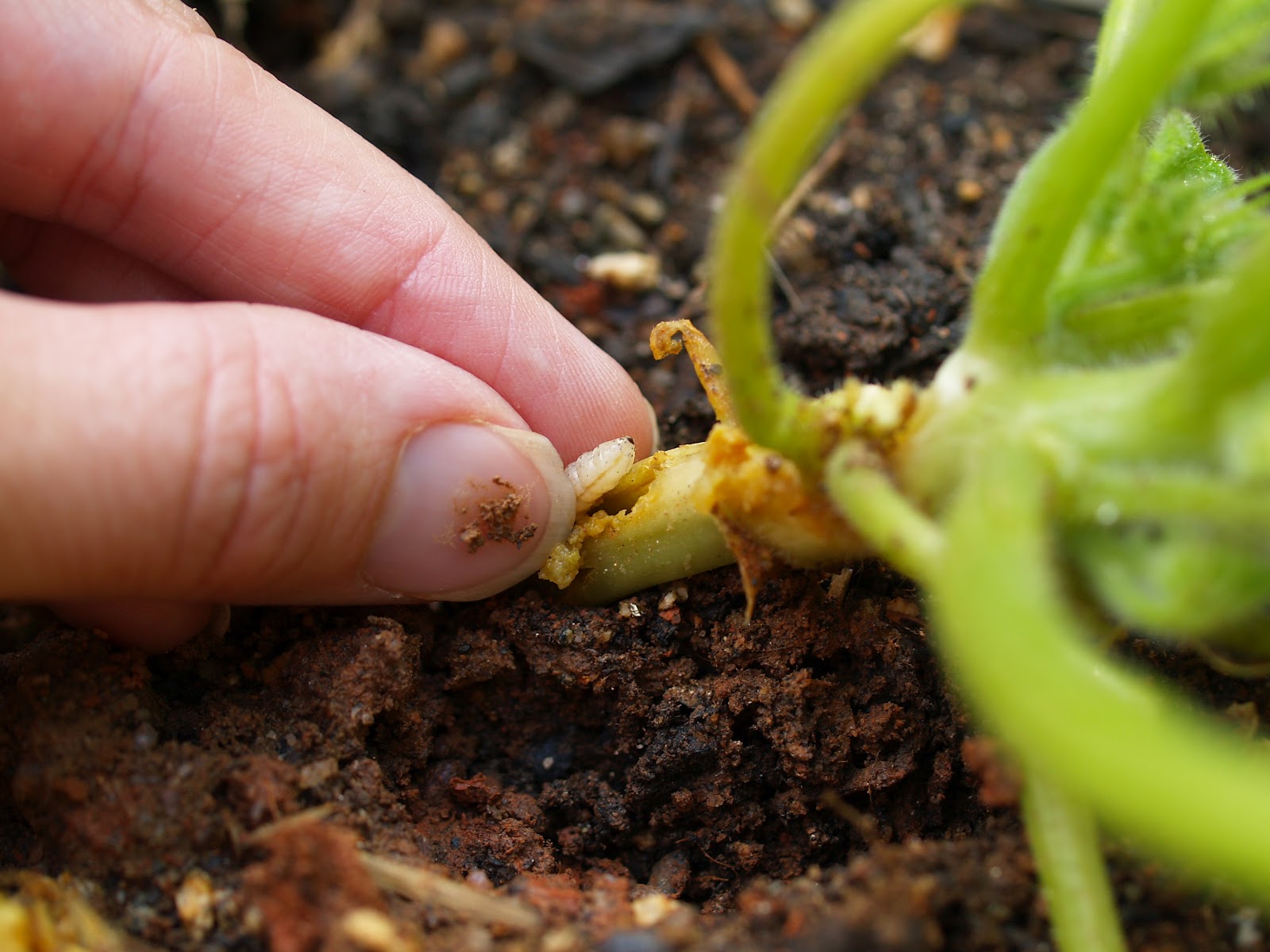
There are few things I truly hate, but vine borers make it to the top of my list. If you have never met a vine borer as a gardener, count yourself lucky. They are a species of moth that lay their eggs on the stem of squash plants. The caterpillars then eat into the stem of the squash and cut off the transport and nutrients and water from the roots to the leaves. The squash start to wilt and the entire plant dies. Plus, in the south we have a long enough season to get two rounds of vine borers.
This year I had a battle plan for the vine borers.
Step 1: Plant resistant squash varieties. C. moschata varieties are suppose to be more resistant to the borers. I planted tromboncino squash which can be picked young and can be used as a summer squash. I also planted Sweet Mama Hybrid squash which is a acorn squash that is *suppose* to be resistant.
Step 2: Plant a trap crop. Hubbard squash are suppose to be one of their favorite varieties, so my plan was to plant them as a trap crop and kill the evil borers!
My battle plan is not going as expected! My sweet mama squash started wilting (remember that this one is suppose to be resistant). Checking out the stem, this is a red flag that there's a vine borer inside:
Sometimes you can cut out the vine borer and bury the damaged part of the stem and the plant will survive. I tried this and here you can see my archenemy:
Don't be fooled by its small and harmless appearance- these guys are evil!
I buried the stem and hoped for the best. Unfortunately the plant wilted and died. I pulled it up and found that there was a second vine borer!
Casualties:
7 of the 9 Mama Hybrid Squash have died
1 of 3 Hubbard Squash have died
0 of 6 Tromboncino Squash have died
The trap crop is doing better than one supposedly resistant variety, but so far tromboncino is the survivor. All three hubbard squash have been attacked, two have survived so far. I cut one borer out of the one that died. As the plant continued to die, I pulled it and opened it up. There were four more vine borers! I've never seen that many before and this was at the end of May!
And the battle goes on...
Any suggestions on how to win the battle or even how to survive the battle with a few squash plants alive?
This year I had a battle plan for the vine borers.
Step 1: Plant resistant squash varieties. C. moschata varieties are suppose to be more resistant to the borers. I planted tromboncino squash which can be picked young and can be used as a summer squash. I also planted Sweet Mama Hybrid squash which is a acorn squash that is *suppose* to be resistant.
Step 2: Plant a trap crop. Hubbard squash are suppose to be one of their favorite varieties, so my plan was to plant them as a trap crop and kill the evil borers!
My battle plan is not going as expected! My sweet mama squash started wilting (remember that this one is suppose to be resistant). Checking out the stem, this is a red flag that there's a vine borer inside:
Sometimes you can cut out the vine borer and bury the damaged part of the stem and the plant will survive. I tried this and here you can see my archenemy:
Don't be fooled by its small and harmless appearance- these guys are evil!
I buried the stem and hoped for the best. Unfortunately the plant wilted and died. I pulled it up and found that there was a second vine borer!
Casualties:
7 of the 9 Mama Hybrid Squash have died
1 of 3 Hubbard Squash have died
0 of 6 Tromboncino Squash have died
The trap crop is doing better than one supposedly resistant variety, but so far tromboncino is the survivor. All three hubbard squash have been attacked, two have survived so far. I cut one borer out of the one that died. As the plant continued to die, I pulled it and opened it up. There were four more vine borers! I've never seen that many before and this was at the end of May!
And the battle goes on...
Any suggestions on how to win the battle or even how to survive the battle with a few squash plants alive?
Tuesday, May 22, 2012
The Battle for Strawberries
Spring started off with a bounty of strawberries. I had about 3 1/2 lbs of oh so yummy strawberries. I even had enough to make strawberry sauce for an angel food cake. Life was good.
Then the strawberries started disappearing. First it was the ripe ones. Then even the green ones were pulled off and often abandoned.
A war had begun.
I assumed my enemy was the squirrels. They run along the back fence and hop into the garden. I have definitely caught them in the strawberry patch before. My strategy was to build a squirrel proof cage so I could have delicious strawberries again!
I bought 1 inch plastic hexagon netting and used rebar and plastic piping to make the structure (this is what I use for my cold frames, so I had it available). With a bit of cutting and zip ties to hold the pieces together, I had my squirrel exclosure:
I anchored the edges with retaining wall bricks and prepared to have tasty strawberries again.
I watched and waited for the strawberry to ripen and one morning it almost looked ready. By the afternoon it was gone! Vanished!
Then the strawberries started disappearing. First it was the ripe ones. Then even the green ones were pulled off and often abandoned.
A war had begun.
I assumed my enemy was the squirrels. They run along the back fence and hop into the garden. I have definitely caught them in the strawberry patch before. My strategy was to build a squirrel proof cage so I could have delicious strawberries again!
I bought 1 inch plastic hexagon netting and used rebar and plastic piping to make the structure (this is what I use for my cold frames, so I had it available). With a bit of cutting and zip ties to hold the pieces together, I had my squirrel exclosure:
I anchored the edges with retaining wall bricks and prepared to have tasty strawberries again.
I would love to say this story has a happy ending- the war was over and I won and celebrated by eating lots of strawberries. Sadly that is not what happened. There was a ripening strawberry in the center of the cage:
The war continues. Perhaps my enemy was not the squirrels and is a vole living under my strawberry bed. I now have a mysterious enemy, which is making the battle for strawberries difficult!
Subscribe to:
Posts (Atom)